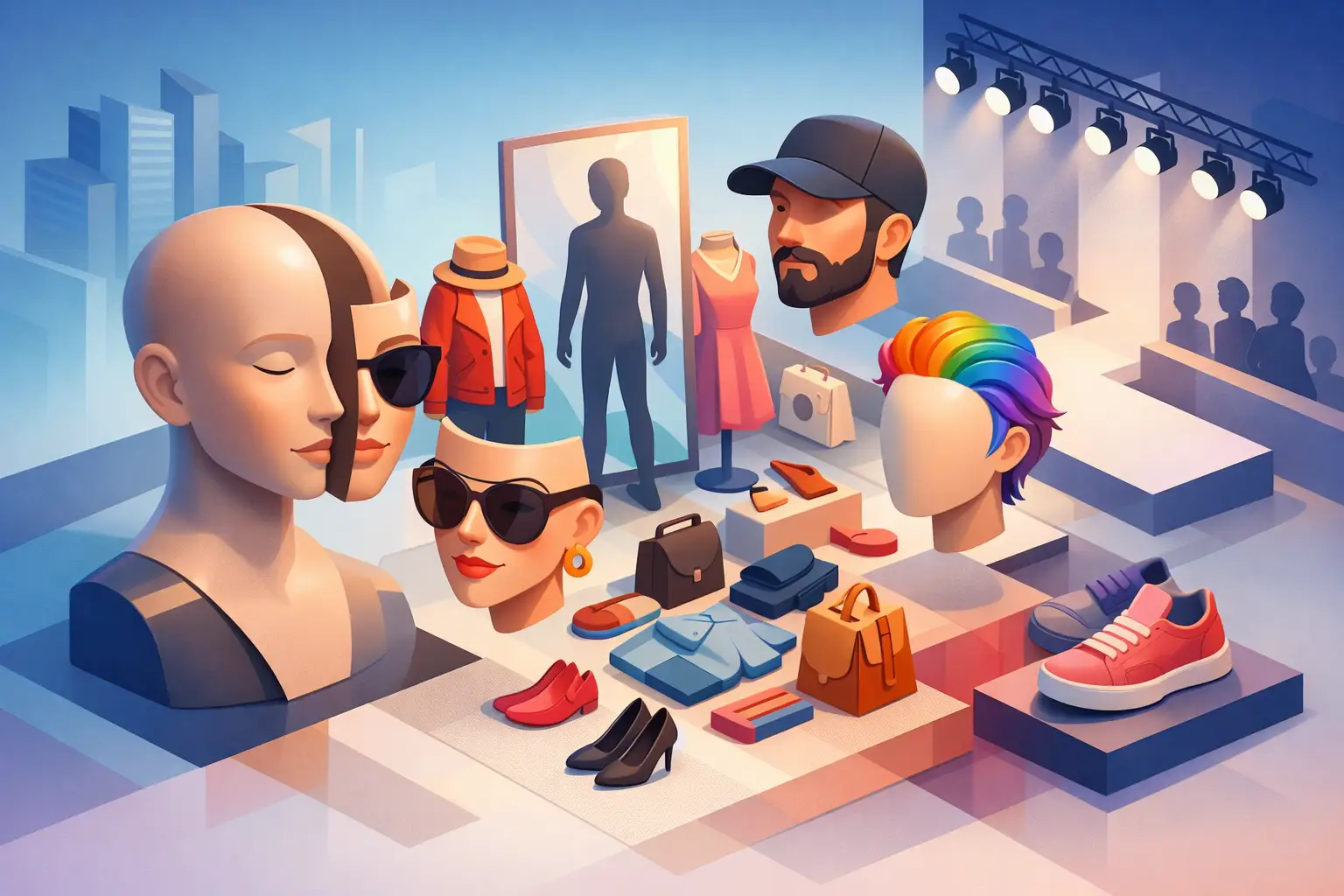
A plain tee is never just a plain tee once you care about what it says about you. That is the core of identity driven fashion. It is not only about looking good. It is about wearing your taste, your attitude, your politics, your scene, your mood, and your sense of self before you even say a word.
That shift changed the whole game. People are not getting dressed just to match a trend report or copy a mannequin. They are building a visual language. Streetwear saw this early. A fit could signal what music you move with, what city shaped you, what energy you bring, and what kind of crowd you belong to. The clothes became the message.
What identity driven fashion really means
Identity driven fashion is style built around self-definition. Not fashion for approval. Not fashion for dressing "correctly." It is clothing chosen because it feels aligned with who you are or who you want to become.
Sometimes that identity is loud. Graphic prints, oversized cuts, sharp color, statement outerwear. Sometimes it is quiet. Clean lines, niche references, a specific silhouette only the right people catch. Both count. The point is intention.
That is why identity-driven style does not fit neatly into one aesthetic. It can live in skate culture, luxury minimalism, punk, workwear, Afrofuturism, DIY fashion, sneaker culture, gender-fluid styling, or hometown pride. The throughline is not the look itself. The throughline is meaning.
Why identity driven fashion matters more now
The old fashion model was simple. Brands told people what was in, and people followed. That still exists, but it does not hit the same way. Younger shoppers grew up online, surrounded by micro-scenes, niche communities, and endless visual references. They learned early that style is personal branding, social signaling, and cultural participation all at once.
When everything is visible, generic gets ignored. People want pieces that feel like receipts of who they are. Not just what they can afford. Not just what a big retailer pushed this month.
There is also a trust issue. A lot of mass fashion feels empty because it is built to offend nobody and mean nothing. Identity driven fashion pushes the other way. It says pick a side. Show your taste. Wear the thing that actually reflects you.
That does not always mean being extreme. It means being specific. Specific usually reads stronger than loud.
Streetwear understood this before most brands did
Streetwear has always been bigger than garments. It came up through scenes, not boardrooms. Skate. Hip-hop. Graffiti. Sneakers. Local codes. Regional flavor. It was never only about fabric and fit. It was about belonging, rebellion, taste, and recognition.
That is why streetwear still carries weight when luxury copies the surface. The real value is not just the hoodie. It is the point of view behind the hoodie.
A strong streetwear brand does not ask, "What should we sell this season?" It asks, "What are we saying?" That is a different mindset. The first one produces product. The second one produces identity.
For shoppers, that difference is obvious. You can feel when a brand has a voice and when it is just printing graphics to chase traffic. One feels lived in. The other feels borrowed.
Style as signal, not costume
Here is where people get it wrong. Identity driven fashion is not about faking depth with statement pieces. If the clothes wear you, the signal falls apart.
Real identity-led style has coherence. It looks like the choices came from somewhere real. Maybe that is your music taste. Maybe it is your neighborhood. Maybe it is your creative work, your politics, your sense of humor, or the way you move through gender and culture. The fit makes sense because the person makes sense.
That does not mean you have to stay the same. Identity shifts. Good style shifts with it. Some days you want clean and cut back. Other days you want heavy graphics and energy. Both can be honest if they connect to your actual mood and life.
The line between style and costume usually comes down to one thing: are you expressing, or are you performing? Sometimes it is both. But if performance is all that is there, people can tell.
The trade-off: individuality vs trend pressure
Everybody says they want originality. At the same time, most people still want social proof. That tension sits right in the middle of identity driven fashion.
On one side, dressing with intention feels powerful. On the other, there is pressure to make that identity legible online. The result is a lot of people chasing uniqueness in very similar ways. Same shoes. Same cargos. Same "curated" mess. Same references.
This does not make identity-driven fashion fake. It just makes it complicated. We all build style from shared influences. Nobody creates in a vacuum. The real question is whether you stop at imitation or turn your influences into something personal.
That is where taste comes in. Taste is not about buying the rarest item. It is about editing. Knowing what belongs on you and what does not. Knowing when to hold back. Knowing when one piece says more than a full stacked fit.
Why graphics, slogans, and symbolism still work
People love to act like statement fashion is dead every few years. Then a shirt with the right phrase, the right print, or the right visual attitude cuts through again.
That happens because words and symbols still carry force. They can communicate humor, resistance, confidence, irony, pride, or affiliation in one hit. In identity driven fashion, graphics are not decoration. They are language.
But there is a catch. If the message is weak, obvious, or trend-chasing, the piece dies fast. Strong statement apparel works when it feels rooted in a real worldview. It does not need to explain itself for three paragraphs. It just needs to land.
That is where brand voice matters. When a label knows what it stands for, even a simple tee can feel sharper. Fresh Po'Boy sits in that lane. Streetwear that speaks only works if the voice behind it is clear.
Identity driven fashion is also about community
Personal style feels individual, but it is never fully solo. Every look references somebody, somewhere. A subculture. A city. A generation. A scene. Identity gets shaped in public.
That is part of the appeal. Clothing helps people find each other. You spot a certain silhouette, a certain sneaker pairing, a certain graphic code, and you already know there is overlap. Maybe not in everything, but enough.
This matters even more now because so much life is filtered through screens. People still want real-world signals. They still want visual cues that say, "I know what this is" or "I am part of that energy too."
Good fashion brands understand this. They are not only selling items. They are building a world people want to step into. The strongest ones make customers feel seen before they ever make them feel sold to.
What separates real identity-led brands from empty hype
A lot of brands talk about self-expression. Fewer actually build for it.
The empty version leans on recycled slogans, fake exclusivity, and trend timing. It treats identity like a marketing prop. The product might get attention for a second, but it rarely sticks.
The stronger version has a point of view that runs through everything - design, fit, naming, visuals, tone, even what the brand chooses not to do. It knows not every piece has to appeal to everybody. That focus is the whole point.
Consumers are sharper than brands think. They can tell when something is made by people with real taste versus people trying to reverse-engineer culture from analytics.
Where identity driven fashion goes next
It is probably getting more specific, not less. More niche references. More local energy. More personality. Less interest in looking polished for everyone.
That does not mean trends disappear. Trends will always move. But the brands and people that last will be the ones who can absorb trends without losing themselves.
Expect more mixing too. Luxury with thrift. Vintage with techwear. Quiet basics with one hard statement piece. The future is less about fitting into one tribe perfectly and more about building a style language that feels true across influences.
That is the real power here. Identity driven fashion gives people a way to be recognizable without being uniform. It turns getting dressed into something closer to authorship.
Wear what carries your voice. Not just what fills space on your body. The strongest fit is the one that says something real before you even open your mouth.