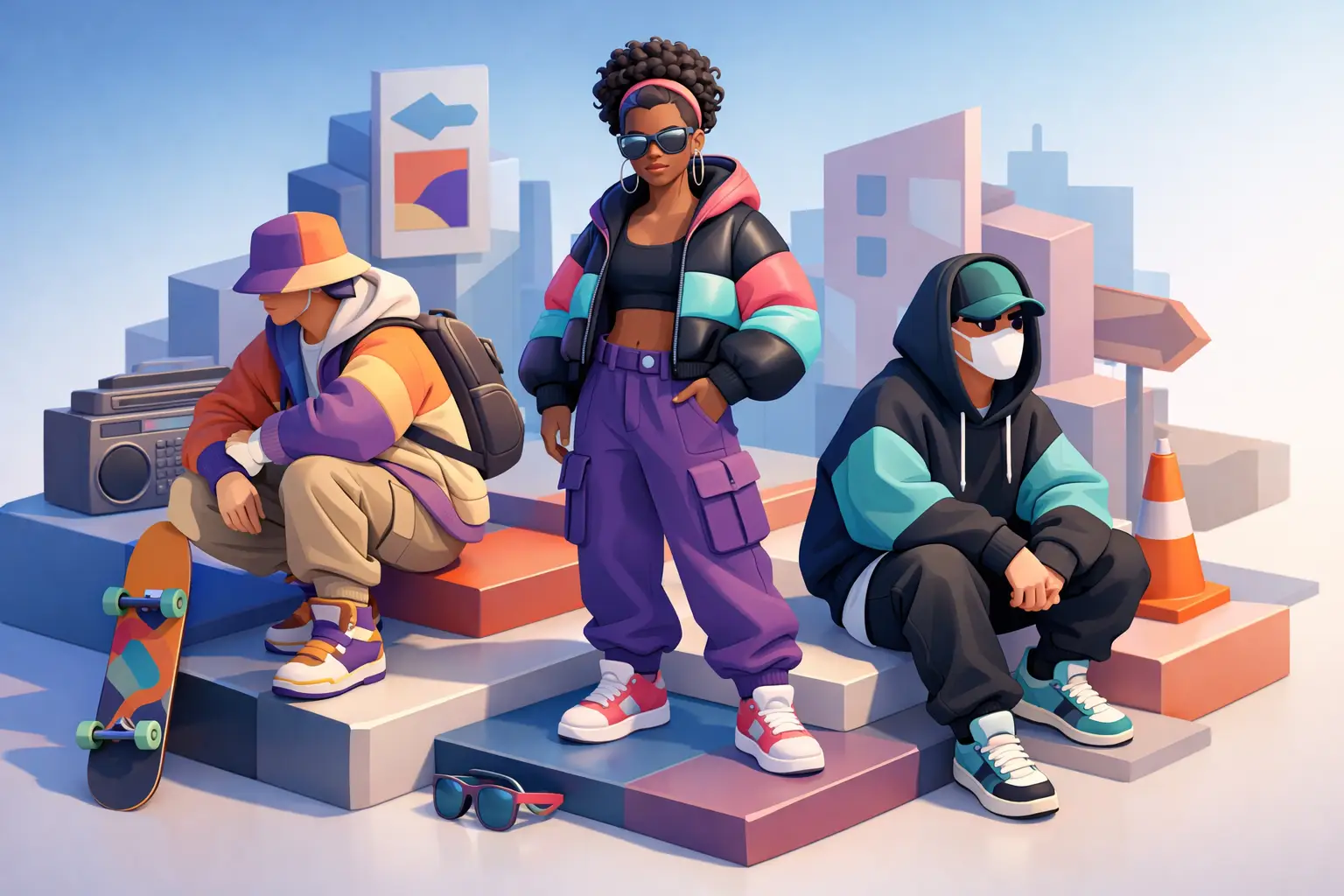
The fastest way to look forgettable is dressing like a mood board.
That is why streetwear for individuality matters. Not the copy-paste version. Not the head-to-toe trend uniform. Real personal style has tension in it - something clean mixed with something loud, something familiar pushed slightly off-center. The best fits do not beg for approval. They say what they need to say and keep moving.
Why streetwear for individuality still matters
Streetwear has always been tied to identity. It came from scenes, not boardrooms. Skate spots, music, art, local style codes, neighborhood energy - all of that shaped what people wore and why they wore it. That is what gave streetwear weight in the first place.
Now the look is everywhere, which is both good and bad. More access means more people can build style on their own terms. But it also means a lot of outfits start feeling factory-made. Same sneakers. Same oversized tee. Same cargos. Same gray-on-gray-on-gray. When everybody is following the same formula, the fit stops saying anything.
Individuality is what brings the point back. It turns clothing from product into signal. It tells people what you are into, how you carry yourself, what kind of energy you are on. Good streetwear does not just look current. It feels specific.
What makes a fit feel personal
A personal fit usually has one clear idea behind it. Maybe the graphic says something sharp. Maybe the silhouette is doing the talking. Maybe the whole look is stripped back except for one piece that carries attitude. The point is not randomness. The point is choice.
That is where a lot of people get it twisted. Dressing for individuality does not mean wearing the wildest thing you can find. Loud is not always original. Sometimes the strongest personal style is controlled. A clean hoodie, broken-in denim, and one graphic that actually means something can say more than five trend pieces fighting each other.
The real marker of individuality is consistency. Not wearing the exact same thing every day, but having a point of view people can recognize. Maybe you lean monochrome. Maybe your thing is aggressive graphics. Maybe you keep everything minimal and let shape do the work. Personal style lands harder when it feels intentional over time.
Identity shows up in the details
Small decisions do a lot of heavy lifting. Fit matters more than people admit. A boxy tee reads differently from a slim one. Cropped outerwear creates a different shape than an oversized layer. Stacked pants hit differently than a cleaner break at the shoe.
Then there is texture, color, and wear. Crisp cotton feels different from washed fabric. Bright color can feel confrontational in the best way, while faded black can feel more lived-in and grounded. None of these choices are minor when the whole point is expression.
Accessories count too, but only when they match the energy of the outfit. The wrong bag, cap, or jewelry can make a fit feel overworked fast. The right one can make it feel finished without trying too hard.
The difference between style and costume
Streetwear gets weak when it starts looking like a costume. That happens when the outfit is built to fit a category instead of a person. You can spot it immediately - every piece is technically on trend, but the person disappears inside it.
Style starts from the other direction. You build around your own habits, your own references, your own comfort level. If you hate stiff denim, forcing yourself into it because it is trending will show. If you never wear bright color, suddenly throwing on neon everything will probably wear you instead of the other way around.
That does not mean stay safe forever. It means experiment in a way that still feels like you. Push one thing at a time. Try a stronger silhouette with familiar colors. Try a louder graphic on a shape you already trust. Streetwear for individuality works best when the risk feels wearable, not theatrical.
How to build streetwear for individuality without forcing it
Start with the pieces you reach for most. Not the ones you wish you wore. The ones that already fit your life. Then ask a better question than what is trending. Ask what is missing.
Maybe your lineup has solid basics but no statement piece. Maybe everything is graphic-heavy and you need cleaner layers to balance it out. Maybe the clothes are good but the fit is too safe across the board. That gap is where individuality starts to show up.
A strong wardrobe usually has a mix of anchors and disruptors. Anchors are the pieces that make getting dressed easy - the hoodie that always works, the pants with the right shape, the jacket that pulls everything together. Disruptors are what keep the look from getting too predictable. A sharp phrase. A bold print. An unexpected color hit. A cut that changes the whole silhouette.
The balance matters. Too many disruptors and the outfit starts yelling over itself. Too many anchors and it goes flat. The sweet spot depends on your taste, which is exactly the point.
Graphics should say something
In a space this visual, graphics are never just decoration. They signal taste, attitude, humor, frustration, confidence, whatever you want to put into the room before you even speak. That is why generic graphics fall apart fast. If the print looks like it could belong to anybody, it usually means nothing.
The best graphic streetwear has point of view. It feels like a statement, not filler. Sometimes that statement is blunt. Sometimes it is subtle. Either way, it should add identity, not just surface noise.
This is where brands with an actual voice stand out. Fresh Po'Boy, for example, leans into the idea that clothing should talk back a little. That works because people are not just buying fabric. They are buying a way to show up.
Trends are tools, not rules
You do not have to reject trends to have personal style. You just cannot let them run the whole show.
A trend can be useful when it gives you a new shape, color, or styling move that fits your lane. It becomes a problem when you wear it just because everyone else is. There is a difference between adapting a trend and disappearing into one.
Take oversized fits. For some people, that shape feels natural and strong. For others, it kills the whole look and leaves them looking swallowed. Same trend, different result. The answer is not whether oversized is in or out. The answer is whether it works on you and fits the message you want your clothes to send.
That is the trade-off with every trend cycle. It offers inspiration, but it can flatten originality if you follow it too literally. Use trends like seasoning. Enough to sharpen the fit, not enough to erase your taste.
Individuality is also about confidence
Even the right clothes fall flat if you wear them like you are asking for permission. Individuality is not just the garment. It is the energy behind it.
That does not mean you need to be the loudest person in the room. Quiet confidence hits just as hard. Sometimes harder. A simple fit with a strong stance can do more than a complicated one worn nervously.
This is another reason personal comfort matters. If you are adjusting your clothes all day, second-guessing every piece, or wearing something that does not match your actual life, people can feel it. The fit loses pressure. Confidence comes easier when the look feels aligned instead of borrowed.
What to avoid if you want your style to stand out
The biggest mistake is over-curating every outfit for the internet. That usually strips the life out of it. Real style needs some instinct. Some mess. Some choices that make sense to you even if they are not optimized for likes.
Another mistake is chasing rarity instead of relevance. Limited pieces can be fire, but exclusivity alone does not create individuality. If the piece has no connection to your style, it is just expensive noise.
And then there is the trap of dressing entirely for one scene. Sneakers, music, art, and streetwear all overlap, but you do not need to perform full membership in every culture you touch. It is better to pull influence from different places and make it yours than to cosplay credibility.
Streetwear that actually speaks
The strongest streetwear feels lived in, not assembled by algorithm. It reflects what you notice, what you care about, what kind of presence you want to have. That can look bold and graphic. It can look stripped down and precise. It can shift over time. The point is that it stays yours.
So if your closet feels a little too predictable, do not just buy louder clothes. Buy sharper ones. Pieces with attitude. Pieces with a real point of view. Streetwear for individuality is not about getting seen by everybody. It is about being recognized by the right people, including yourself.
Wear what speaks before you do.